
The First Clatter: Vitaphone, Movietone, and the Sound Revolution
The arrival of synchronized sound in motion pictures was not a singular event, but a technological race between two competing systems. Vitaphone and Movietone fundamentally reshaped the mechanics of filmmaking, creating new departments and altering the studio floor forever.
The sudden eruption of sound onto the silent screen in the late 1920s was a mechanical marvel, not a creative whim. For decades, the moving image had captivated audiences in silence, accompanied by live orchestras and pianists. But behind the scenes, inventors and engineers tirelessly pursued the holy grail: a perfectly synchronized marriage of picture and sound. This quest culminated in a furious race, primarily between the sound-on-disc Vitaphone system and the sound-on-film Movietone method, each forcing studios to rapidly retool their entire production apparatus.
Vitaphone: Sound on Disc Takes the Stage
The first significant contender to reach a wide audience was Vitaphone, a system developed by Western Electric and acquired by Warner Bros. in 1925. Its core principle was simple, yet fraught with potential for error: sound was recorded onto a separate, large 16-inch wax disc, synchronized to a particular reel of film. On the studio floor, recording involved capturing audio through microphones and cutting it directly onto these discs, often at 33 1/3 RPM, a speed chosen for its ability to hold more audio information than earlier formats.
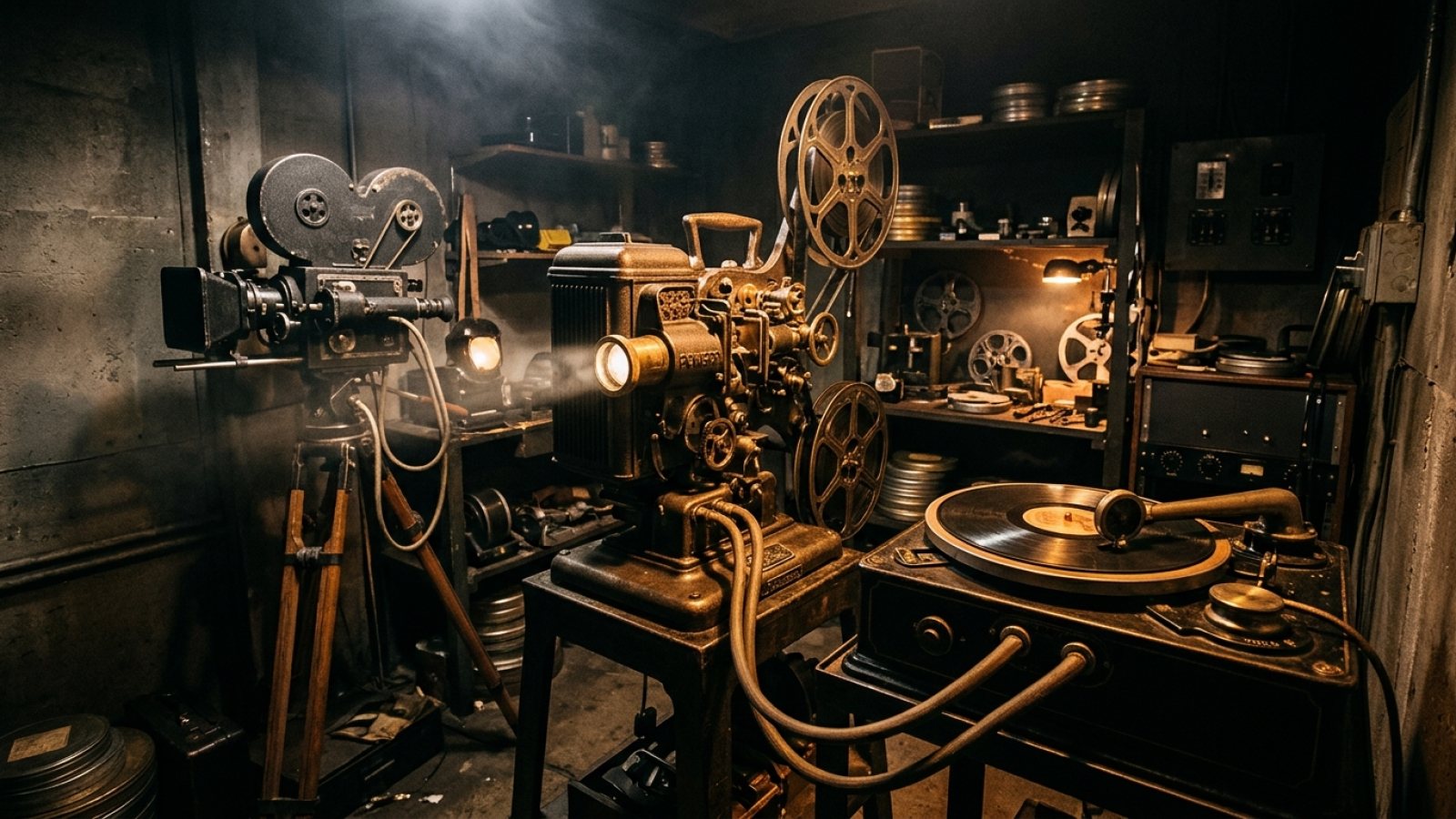
In the theater, a specially modified projector, often a Powers or Simplex model, was electronically interlocked with a turntable and tone arm. As the film ran, an electrical motor ensured that the projector and the phonograph rotated in unison, delivering the sound through amplifiers to large, horn-loaded speakers behind the screen. The debut of Don Juan in August 1926 showcased Vitaphone's capacity for synchronized musical scores and sound effects, demonstrating that sound could indeed be reliably presented with a feature film. A year later, The Jazz Singer delivered not just a musical score, but synchronized dialogue, shattering the silent era's reign and proving the commercial viability of talkies.
For the studios, Vitaphone demanded a complete overhaul. Cameras had to be encased in large, soundproof booths called 'blimps' to muffle their clatter. Microphones were stationary, limiting actor movement and blocking dynamic camera work. Editing sound was a separate, cumbersome process from editing film, and if a disc broke or the interlock slipped, synchronization could be lost entirely, turning a dramatic scene into an unintentional comedy.
Movietone: The Dawn of Optical Sound
While Vitaphone made its mark, another, ultimately more enduring technology was rapidly developing: sound-on-film. Spearheaded by Fox Film Corporation, in collaboration with engineers Theodore Case and Earl Sponable, Movietone recorded the sound directly onto the film strip itself, alongside the visual image. The breakthrough came with the Case Research Lab's development of a variable-density optical soundtrack.
On set, a specially designed sound camera used a device called a 'light valve.' This valve, essentially a tiny ribbon of duralumin, vibrated in response to sound waves captured by the microphone. As light passed through the vibrating ribbon, it exposed a varying amount of light onto the film's edge, creating a photographic record of the sound waves – a continuous, wavy line of varying opacity. In the projection booth, a photoelectric cell focused a narrow beam of light through this optical soundtrack. As the film moved, the varying opacity of the track modulated the light reaching the cell, converting the light fluctuations back into electrical signals that were then amplified and sent to the speakers.
Movietone's advantages were immediate and profound. Synchronization was absolute, as picture and sound were irrevocably bound on the same celluloid strip. Editing became far more integrated, with sound and picture cuts made simultaneously. The cumbersome discs and their logistical nightmares vanished. While early Movietone cameras were still bulky, the inherent portability and editability of the system quickly made it the standard for newsreels and features. Fox Movietone News, launched in 1927, quickly demonstrated the system's ability to capture live events with synchronized sound, cementing its superior practicality.
The Industrial Shift
The competition between Vitaphone and Movietone, and other emerging sound systems like RCA Photophone, forced the entire film industry into a technological maelstrom. New departments for sound recording, mixing, and engineering sprang up overnight. Studios invested millions in soundproof stages, specialized microphones, and redesigned cameras. The craft of filmmaking, once primarily visual, now had to account for acoustics, dialogue delivery, and the nuanced interplay of sound and image. Movietone's sound-on-film method ultimately proved dominant, its seamless integration and robust synchronization paving the way for the industry's rapid adoption of talkies. The age of silent film ended not with a whimper, but with the distinct hum of a projector's photoelectric cell reading an optical soundtrack.
