Universal City, 1915: The Studio as a Self-Contained Industrial Town
In 1915, Carl Laemmle didn't just build a studio; he founded a sprawling, self-sufficient municipality dedicated entirely to film production. Universal City revolutionized moviemaking by centralizing every aspect of the craft into a singular, factory-like operation.
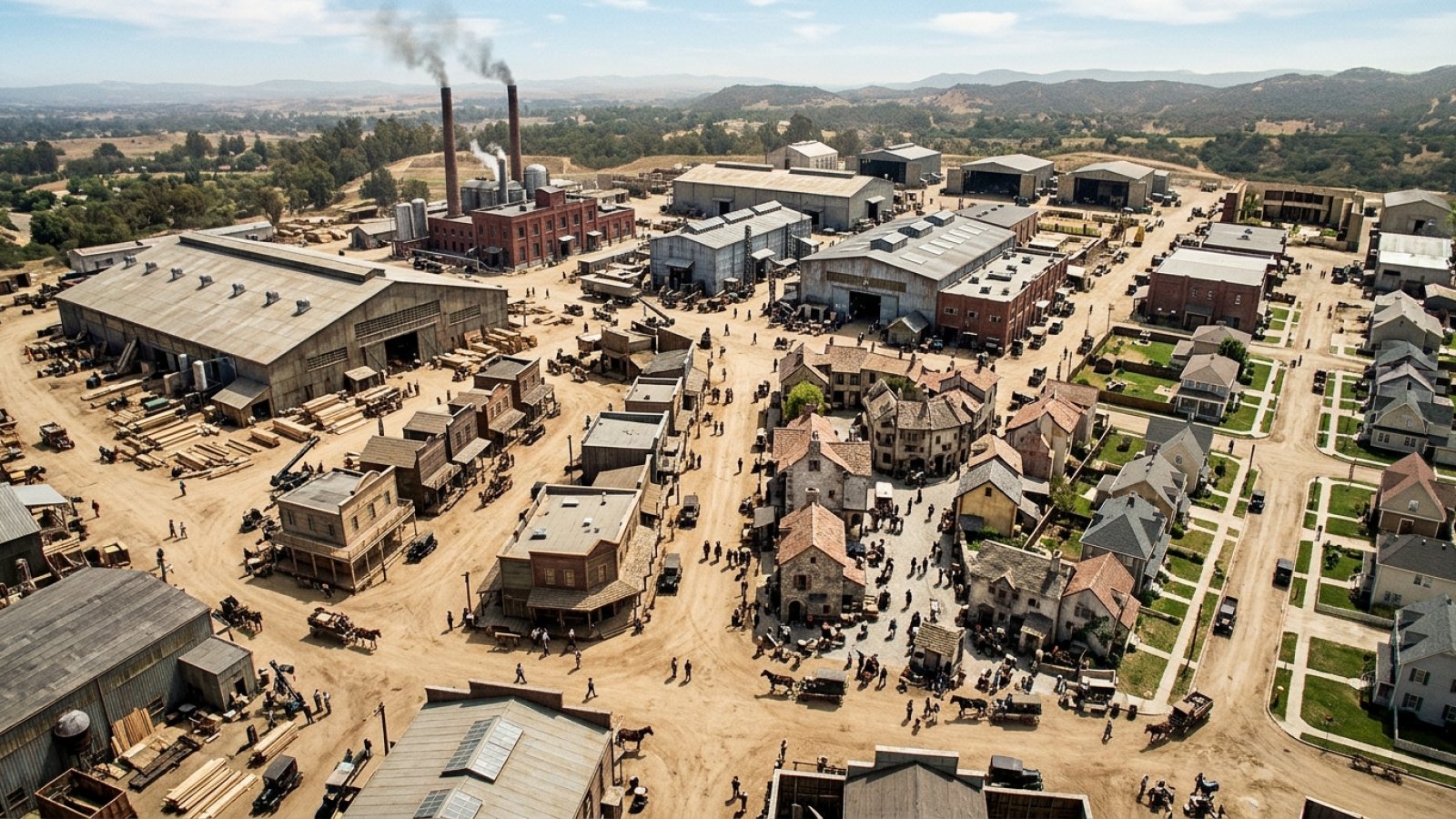
When Carl Laemmle opened Universal City on March 15, 1915, he unveiled more than just a new studio; he presented an industrial municipality, purpose-built and entirely dedicated to the factory-scale production of motion pictures. Situated on 230 acres in the San Fernando Valley, this sprawling complex was designed to be wholly self-sufficient, consolidating every tool and every process of filmmaking into one location, and setting a blueprint for the modern studio system.
Before Universal City, film production was often a more fragmented affair, with locations, workshops, and processing labs scattered across different sites. Laemmle’s vision was to eliminate these inefficiencies by bringing all departments under one roof – or, rather, under one sun. The ambition was to create an environment where a film could be conceived, written, cast, costumed, shot, developed, edited, and prepared for distribution without ever leaving the property.
The Integrated Production Machine
Universal City was an enormous, integrated machine designed to churn out films with unprecedented speed and volume. It housed a dedicated power plant, ensuring consistent electricity for arc lamps and machinery. Water was supplied by its own system, crucial for both daily operations and for creating elaborate outdoor sets like artificial lakes or rivers. The infrastructure included massive carpentry shops where sets were constructed, costume departments capable of outfitting hundreds of extras, and props workshops that could fabricate anything from ancient Roman chariots to Western saloon bars. The lot featured extensive open-air stages, crucial in the era before widespread studio lighting, and an array of backlot sets designed to represent various global locales: a Western street, a European village, a desert landscape, and suburban homes, all ready to be repurposed for different productions. This centralized ecosystem meant that directors could transition from shooting a desert scene to a city street, or from an interior mansion to a ship deck, with minimal travel and logistical delay. For a serial like The Broken Coin, released the same year, the rapid changes in setting and action were facilitated by these on-site resources.
Life and Labor on the Lot
Beyond the technical departments, Universal City was a functioning town, designed to house and sustain its workforce. There were residential bungalows for contract players and crew members, a general store, a bank, a post office, a fire station, a hospital, and a dedicated police force. Livestock pens housed horses, cattle, and other animals, ready for use in Westerns or period dramas. This integration of living and working spaces created a constant, readily available labor pool, maximizing efficiency and minimizing off-site distractions. Actors, technicians, and artisans were always on call, fostering an intense, collaborative atmosphere that was a hallmark of the early studio system. Laemmle even allowed public access to parts of the lot, charging 25 cents for a glimpse behind the scenes, effectively turning the studio into an early tourist attraction and an extension of the marketing department.
The Factory Model's Enduring Legacy
The establishment of Universal City as a complete industrial town profoundly changed the economics and logistics of filmmaking. It solidified the vertical integration model, where studios controlled production, distribution, and exhibition. By centralizing all resources, Laemmle minimized external costs and maximized creative control, allowing for a consistent, high-volume output of features, short subjects, and serials. This model became the template for other major studios, demonstrating the power of owning the entire production pipeline. The sprawling studio lot, with its specialized departments, backlots, and contract crews, became the engine of Hollywood, ensuring that the machinery of moviemaking was constantly humming, turning out new pictures on an almost weekly basis and defining the very industry it served.
