
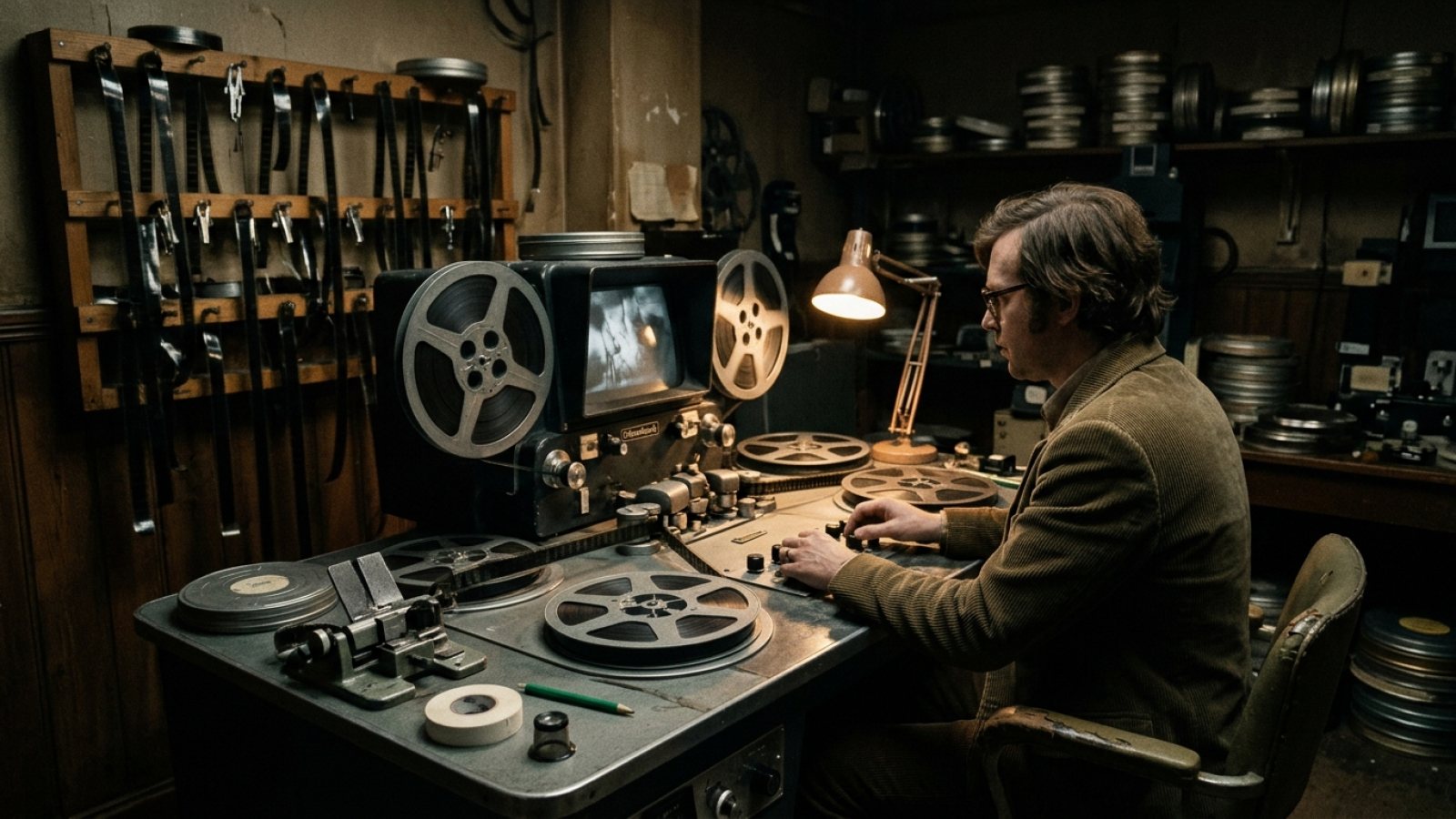
The Flatbed Era: When Editing Was a Physical Craft
Before software timelines, film editors crafted stories with physical strips of celluloid on machines like the Moviola, Steenbeck, and KEM. This era of tactile cutting shaped not only the films themselves but also the language and mechanics of modern digital editing.
Long before the mouse clicked and the digital timeline stretched across a screen, film editing was a precise, physical craft, where stories were quite literally cut and pasted. This labor of hands and machines began with upright viewers and evolved into the sophisticated flatbed editors that defined the golden age of cinema post-war.
In 1924, Iwan Serrurier adapted his film viewer into the Moviola, an upright machine that became the American standard for editors. Resembling a sewing machine with a small screen, the Moviola ran film vertically, allowing an editor to view individual frames or sequences while synchronizing sound from a separate magnetic or optical head. It was a personal, intimate machine, but its vertical design made collaborative viewing difficult and was inherently rougher on film stock due to its intermittent claw mechanism.
From Upright to Flatbed: The Physical Cut
The 1970s marked a significant shift with the widespread adoption of European flatbed editing tables, most notably the Steenbeck and KEM. Wilhelm Steenbeck, who founded his company in Hamburg in 1931, engineered a machine that fundamentally changed the editing environment. Unlike the Moviola, flatbeds ran film horizontally across open platters, allowing for easier handling and inspection. A Steenbeck could run picture and multiple tracks of sound (either optical or magnetic) side-by-side, perfectly synchronized, making it far superior for complex sound design and collaborative work.
Crucially, flatbeds employed a rotating prism for image display instead of the Moviola's intermittent claw. This mechanism pulled the film smoothly and continuously, minimizing wear and tear on precious dailies and work prints. Editors could shuttle film forward and backward at varying speeds, instantly stopping on a single frame without damaging the sprocket holes. This gentle touch was critical, especially with expensive 35mm stock, and allowed for more iterative, confident work.
The Editor's Bench: Crafting the Story Frame by Frame
The workflow on a flatbed was a tangible process, a direct manipulation of celluloid. After shooting, the raw film was developed and printed into "dailies"—a work print that served as the editor's canvas. The editor would load these reels onto the flatbed, watching for performances, pacing, and narrative flow. Cuts were marked directly on the film with a grease pencil, indicating the precise frame where a scene or shot should begin or end.
Once marked, the film was removed from the machine. The editor, armed with a film splicer, would physically cut the celluloid along the grease pencil lines using a sharp blade, then join the desired pieces with transparent splicing tape. Trims and "outs"—discarded footage—were hung on pegs in bins, ready to be retrieved if a sequence needed re-evaluation. Each edited roll of work print contained "edge numbers," latent numbers printed along the film's edge during manufacture, which acted as a vital reference system. These numbers allowed the negative cutter to precisely conform the original camera negative to the approved work print, ensuring that the expensive, pristine negative matched the editor's creative decisions frame for frame for final printing.
This labor-intensive process profoundly shaped cinematography and direction. Every shot, every take, every setup had to be carefully considered, as changes in the editing room meant physical cutting and re-cutting, with potential for damage and added expense. Editors developed an intimate understanding of pacing and rhythm, knowing exactly how many frames equaled a beat or a breath.
Digital Echoes: The Flatbed's Enduring Legacy
The flatbed era began to wane with the advent of digital non-linear editing (NLE) systems. Lightworks, launched in 1989, shipped with a control console specifically designed to emulate the tactile experience of a flatbed, offering jog/shuttle wheels and dedicated buttons that mirrored the physical controls editors were accustomed to. Film editing luminaries like Thelma Schoonmaker, who began her career on Moviolas and flatbeds, adopted these early digital systems, appreciating the familiar interface.
By the mid-1990s, NLEs like Avid Media Composer had largely replaced flatbeds in major studios. Yet, the language and concepts of physical film editing persisted. Digital editing software retained terms like "bins" (where clips are stored, just like physical film trims), "clips" (segments of footage), "trims" (adjustments to a clip's length), and even "splices" and the "blade tool" for cutting. Walter Murch, an editor who honed his craft on Moviola, KEM, and Steenbeck machines, later edited films such as Cold Mountain (2003) on Apple's Final Cut Pro, demonstrating the complete transition from physical to digital, yet carrying the deep understanding of the craft into the new medium.
The flatbed editing machine, once the industrial heart of the editing suite, may no longer be in daily use, but its legacy is etched into the very fabric of how films are made. The precision, the methodical approach, and the tactile understanding of film it fostered continue to inform the digital tools that now dominate the industry, a testament to the enduring principles of a hands-on craft.
