
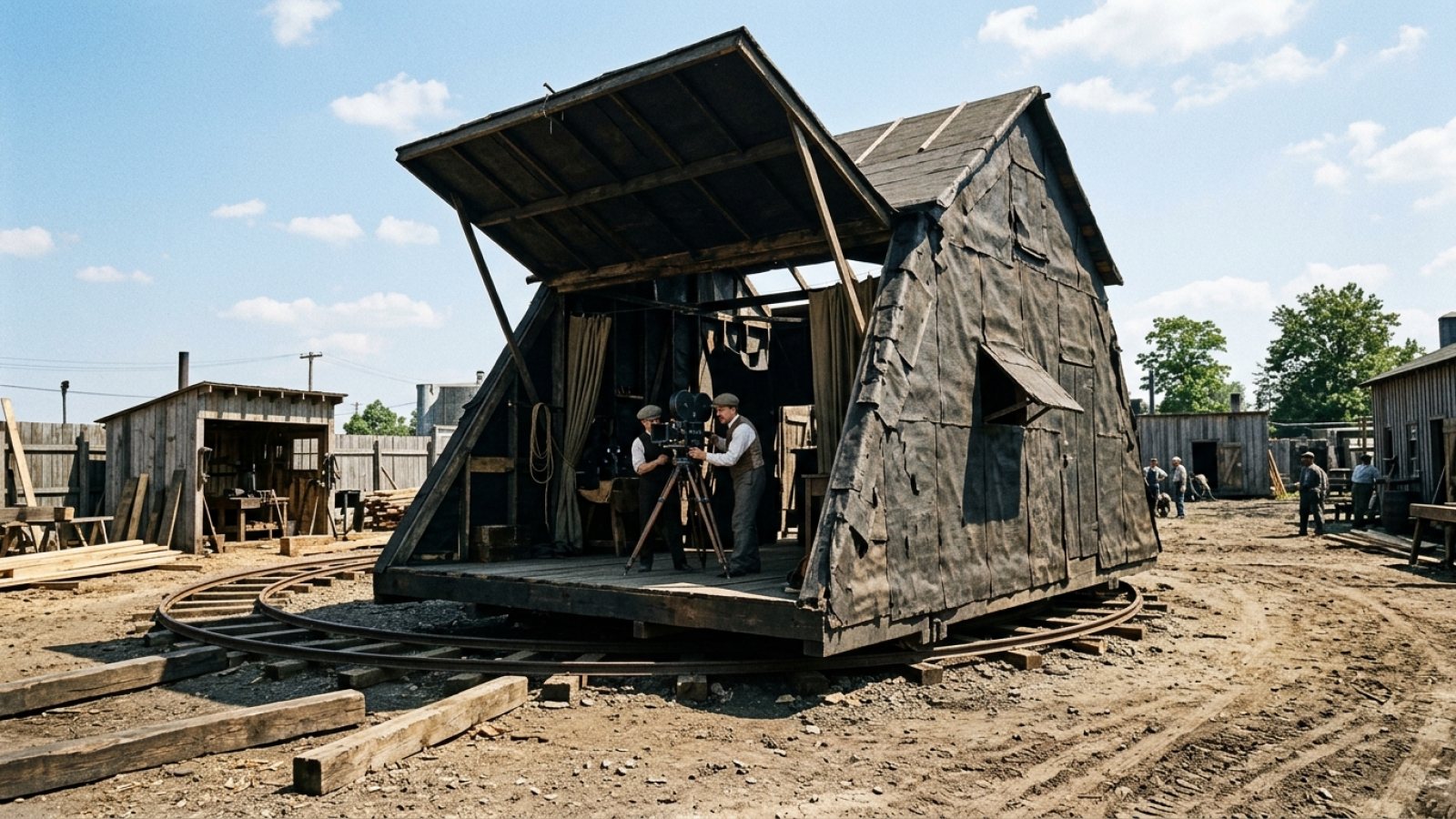
The Black Maria: Edison's Tar-Paper Studio and the Birth of the Film Factory
Before Hollywood’s sprawling soundstages, there was a small, tar-paper shack in West Orange, New Jersey. This was the Black Maria, the world’s first purpose-built film studio, a rudimentary factory designed to manufacture cinematic content.
Long before the grand Hollywood studios rose as film factories, the machinery of moviemaking began in a squat, tar-paper-covered shack in West Orange, New Jersey. This was the Black Maria, built in 1893 by the Edison Manufacturing Company, not as a creative haven, but as an industrial apparatus to produce a steady stream of moving pictures. It was the world's first purpose-built film studio, a direct response to the burgeoning demand for content to feed Thomas Edison's Kinetoscope peep-show machines.
The Sun-Chasing Machine
The Black Maria, colloquially named for its resemblance to police paddy wagons, was a marvel of functional engineering for its time. Constructed primarily of wood and covered in black tar paper, its interior was designed to be as dark as possible to control light, except for its most crucial feature: a massive, hinged roof that could be opened to admit direct sunlight. Early film emulsions, such as the celluloid rolls supplied by Eastman Kodak, were incredibly slow and demanded enormous amounts of light for proper exposure. The open roof acted as a giant, natural skylight, channeling the necessary illumination onto the performers and sets.
Even more ingeniously, the entire structure rested on a circular track, allowing it to be rotated on its axis to follow the sun throughout the day. This constant reorientation ensured maximum light capture for continuous shooting, turning the building itself into a movable part of the photographic process. Inside, the Kinetograph camera, primarily developed by W.K.L. Dickson, was fixed. This robust apparatus, often cited as one of the first successful motion picture cameras, used 35mm film stock, perforated along its edges to enable precise, intermittent movement past the lens. The Black Maria was, in essence, a large, specialized camera obscura, painstakingly engineered to capture fleeting moments onto celluloid with the highest possible clarity available.
From Workshop to Production Line
The construction and operation of the Black Maria represented a profound shift from individual invention to systematic production. Supervised by Dickson and aided by technicians like Charles Kayser and John Ott, the studio was conceived as a workshop to churn out films for commercial distribution. From its completion in early 1894 until 1901, it was the principal site for Edison's film production. The subjects were varied but always brief, tailored to the Kinetoscope's minute-long viewing experience: vaudeville acts, boxing matches, strongmen, dancers, and simple skits.
These early productions included seminal works like Fred Ott's Sneeze (1894), often considered the first copyrighted film, a simple record of an Edison employee sneezing. Other productions featured performers like the Spanish dancer Carmencita (1894), strongman Sandow (1894), and everyday scenes such as The Barbershop (1894) or even animal fights like Cock Fight (1894). These films, though simple, demonstrated the potential for moving images to document and entertain, establishing a commercial pipeline where content was manufactured for a specific consumption device.
Forging the Standard
The Black Maria's legacy extends beyond its pioneering role as a dedicated film studio. The very act of designing a fixed camera within a controlled environment, geared towards producing standardized reels, inadvertently solidified foundational elements of the emerging film industry. The Kinetograph’s use of 35mm film, with its specific perforations, became a de facto standard that would eventually be widely adopted across the industry, facilitating equipment interoperability and paving the way for the exchange of films globally. This standardization was not an artistic choice but an industrial imperative, born from the need to feed machines efficiently.
By establishing a repeatable process for film production—a controlled environment, specialized equipment, and a focused crew turning out short, marketable content—the Black Maria laid the groundwork for the modern studio system. It was the rudimentary prototype of the integrated factory, where raw talent and technology were combined to yield a consistent product. The tar-paper shack, with its turning axis and open roof, was more than just a building; it was the first true cinematic production line, demonstrating that films could be manufactured, not just captured, and setting the stage for the vast industrial complex that cinema would become.
