
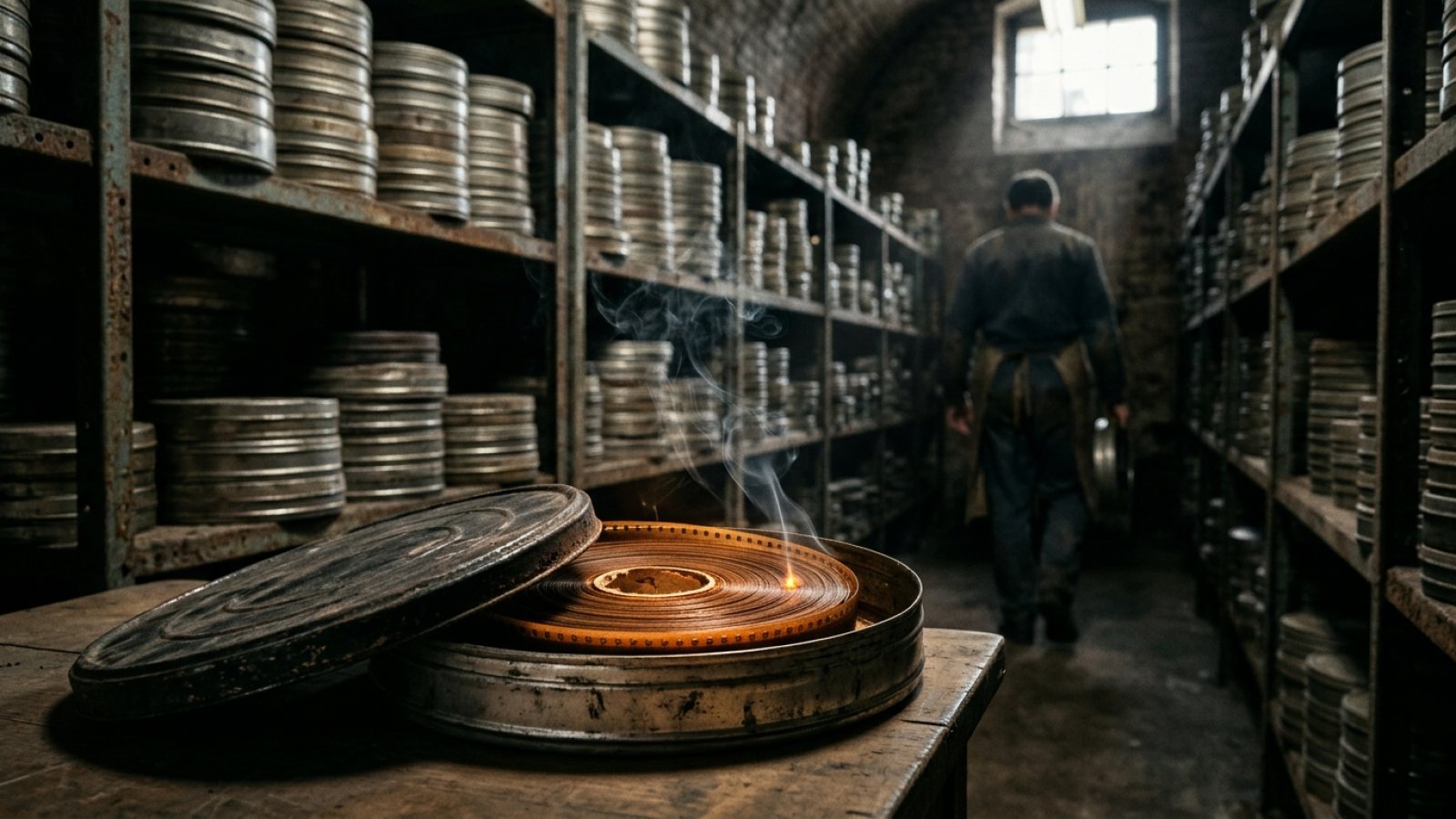
Nitrate: The Unstable Foundation of Hollywood's Golden Age
For decades, the vibrant images of early cinema were etched onto a material both brilliant and inherently volatile. Cellulose nitrate film stock defined the look of classic Hollywood, yet its dangerous properties forced a complete overhaul of the moviemaking process.
Long before digital sensors or even modern safety film, the very essence of moving pictures, from its capture on set to its projection in the darkened theater, was built upon a foundation of cellulose nitrate. This material delivered stunning visual clarity and density that captivated audiences, but it also posed an ever-present, terrifying threat to the people and the art it carried.
The Clarity and the Chemistry
Cellulose nitrate was one of the earliest synthetic plastics, first developed in the mid-19th century. Its origin as gun cotton, an explosive, foreshadowed its future in cinema. When Eastman Kodak began commercializing flexible film bases in the late 1880s, nitrate was the only suitable material available: transparent, durable enough to withstand the mechanical rigors of cameras and projectors, and capable of holding a photographic emulsion. The optical qualities of nitrate film were exceptional. Its high silver content and stable base offered superior sharpness, fine grain, and a wide dynamic range, allowing for rich blacks and detailed highlights. This inherent quality contributed significantly to the iconic look of early Hollywood, where cinematographers like Karl Freund and James Wong Howe pushed the boundaries of light and shadow, confident the material would faithfully record their vision.
On the studio floor, nitrate film was handled with an evolving understanding of its hazards. Fresh stock arrived in light-tight cans, unexposed, ready for the camera. Its robustness meant it could endure repeated passes through complex processing machines in the lab without tearing. But once exposed and developed, the film became an archival challenge, prone to an insidious chemical breakdown known as “nitrate rot,” which could turn a reel first sticky, then brittle, and finally into a corrosive powder over decades. More immediately, however, the problem was fire.
A Volatile Heritage
The danger of nitrate film was not merely a theoretical risk; it was a constant, tangible threat. Cellulose nitrate does not just burn; it self-oxidizes, meaning it carries its own oxygen supply and is incredibly difficult to extinguish once ignited. Fires spread with terrifying speed and heat, often producing toxic gases. Accidents in film vaults, processing laboratories, and projection booths became notorious. Early regulations mandated fireproof projection booths and strict storage protocols, but these measures were reactive, not preventative. The industry recorded numerous catastrophic fires, destroying invaluable film prints and, tragically, claiming lives.
On soundstages, crews learned to manage the risks through careful handling, keeping film stock isolated and in fire-resistant containers. In editing rooms, splices were made quickly, and film scraps were disposed of immediately in metal bins. Every foot of film, from the exposed negative to the final release print, represented a potential inferno. The inherent danger of nitrate wasn't just a cost or an inconvenience; it shaped the very architecture of film facilities, the training of crews, and the insurance premiums paid by studios and theaters.
The Switch to Safety
The search for a safer alternative began early, with Eastman Kodak introducing cellulose acetate “safety film” for narrow-gauge formats like 16mm as early as 1909. However, these early acetate bases suffered from brittleness, excessive shrinkage, and lacked the robust qualities needed for high-speed 35mm production and exhibition. For decades, the superior mechanical and optical properties of nitrate kept it dominant for theatrical distribution, despite the known risks.
It was only after World War II, with advancements in plastic chemistry, that cellulose triacetate emerged as a viable, fire-resistant alternative. This new generation of acetate was significantly more stable and durable, addressing the shortcomings of its predecessors. By the early 1950s, pushed by insurance companies, archivists, and a general awareness of the dangers and preservation crises, major studios and distributors, led by companies like Eastman Kodak, finally transitioned almost entirely to safety film for all new 35mm exhibition prints. The production of nitrate film for theatrical release effectively ceased. While original nitrate negatives are still meticulously preserved in climate-controlled vaults worldwide, their prints, the tangible evidence audiences experienced, were slowly and necessarily replaced by the less flammable, more stable, but visually distinct acetate.
The retirement of nitrate film was a monumental shift in the industrial machinery of moviemaking. It fundamentally altered the material foundation of cinema, trading a beautiful, dangerous past for a safer, if slightly different, future.
