
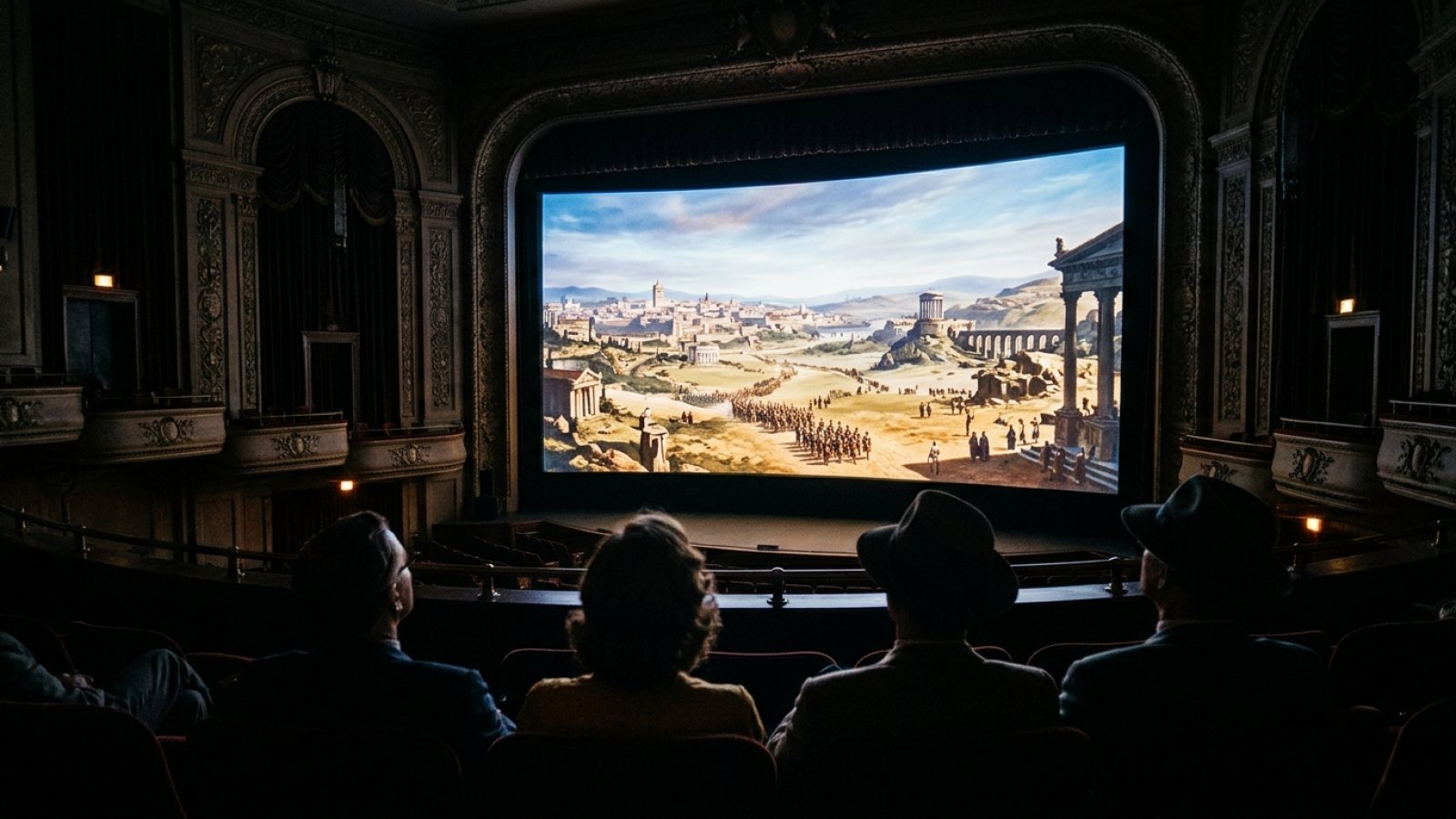
CinemaScope and The Robe: The Widescreen Weapon of 1953
In 1953, Hollywood faced an existential threat from television, which was drawing audiences out of theaters and into living rooms. 20th Century Fox answered with CinemaScope, a technological gambit that forever changed the shape of the screen.
By the early 1950s, the Hollywood studio system was in crisis, hemorrhaging audiences to the flickering, small-screen novelty of home television sets. The industry needed a revolution, a spectacle television could not replicate, and in 1953, 20th Century Fox delivered its answer: CinemaScope, an anamorphic widescreen process that dramatically reshaped the cinematic experience, debuting with the biblical epic The Robe.
The Anamorphic Squeeze
CinemaScope was not an entirely new invention, but a shrewd industrial adoption of existing technology. Its roots lay in the work of French inventor Henri Chrétien, who developed the Hypergonar lens system in the 1920s. This lens featured cylindrical optical elements designed to compress, or 'squeeze,' a wider field of view horizontally onto a standard 35mm film negative. Then, during projection, a complementary lens would 'unsqueeze' the image, restoring its correct proportions on a much wider screen.
20th Century Fox head Spyros Skouras, recognizing the potential of this technology to differentiate cinema from television's square aspect ratio (around 1.33:1), acquired the rights to Chrétien's patents in 1952. Fox then partnered with Bausch & Lomb to manufacture the production-ready anamorphic lenses. When filming, these lenses squeezed a widescreen image onto the traditional 35mm frame. The initial CinemaScope projection standard offered an astounding aspect ratio of 2.55:1, a vast horizontal canvas compared to the standard Academy ratio of 1.37:1.
Remaking the Studio Floor
The introduction of CinemaScope demanded significant adaptations across the studio. The camera department, accustomed to the Academy frame, now had to reckon with the anamorphic lens. While the lenses could be fitted to standard professional cameras like the Mitchell BNC, the optical characteristics of the anamorphic squeeze altered depth of field and created a unique horizontal flare, requiring cinematographers to rethink focus pulling and lighting schemes. Wider sets were necessary, dictating new approaches to art direction and set construction to fill the expanded frame, often emphasizing expansive backdrops over intricate foreground detail.
Perhaps one of the most significant, though often overlooked, changes was in sound. To fully immerse audiences, Fox mandated a four-track stereophonic sound system, using magnetic stripes laminated onto the film print itself, alongside a reduced optical sound track for compatibility. This was a radical departure from the monaural optical sound that had been standard for decades. Sound mixers and engineers had to adapt to multi-channel recording, allowing for directional audio that matched the on-screen action, a crucial component in creating the grand spectacle that The Robe promised.
A Wider Canvas, A Fuller Experience
When The Robe premiered in October 1953, it was more than just a film; it was an event, a declaration of independence from the living room television. The vast, sweeping images, filled with Roman legions and epic landscapes, dwarfed anything available in the home. Directors and cinematographers now had an enormous canvas to compose with, allowing for scenes of grand scale, multiple concurrent actions within a single frame, and panoramic vistas that would have felt cramped in the standard aspect ratio. The ability to place several actors in a frame, fully visible and interacting without immediate cuts, changed blocking and narrative rhythm.
CinemaScope was an industrial gamble, requiring studios to invest in new lenses and cameras, and exhibitors to upgrade their projection systems with wider screens and anamorphic projector lenses. But the gamble paid off. Its immediate success spurred a rush by other studios to develop their own widescreen formats, from VistaVision to SuperScope, all aiming to bring audiences back into the theatrical experience. CinemaScope, with its definitive visual and audio innovations, successfully positioned cinema as the superior spectacle, firmly embedding widescreen filmmaking into the fabric of the industry's production pipeline for decades to come.
