
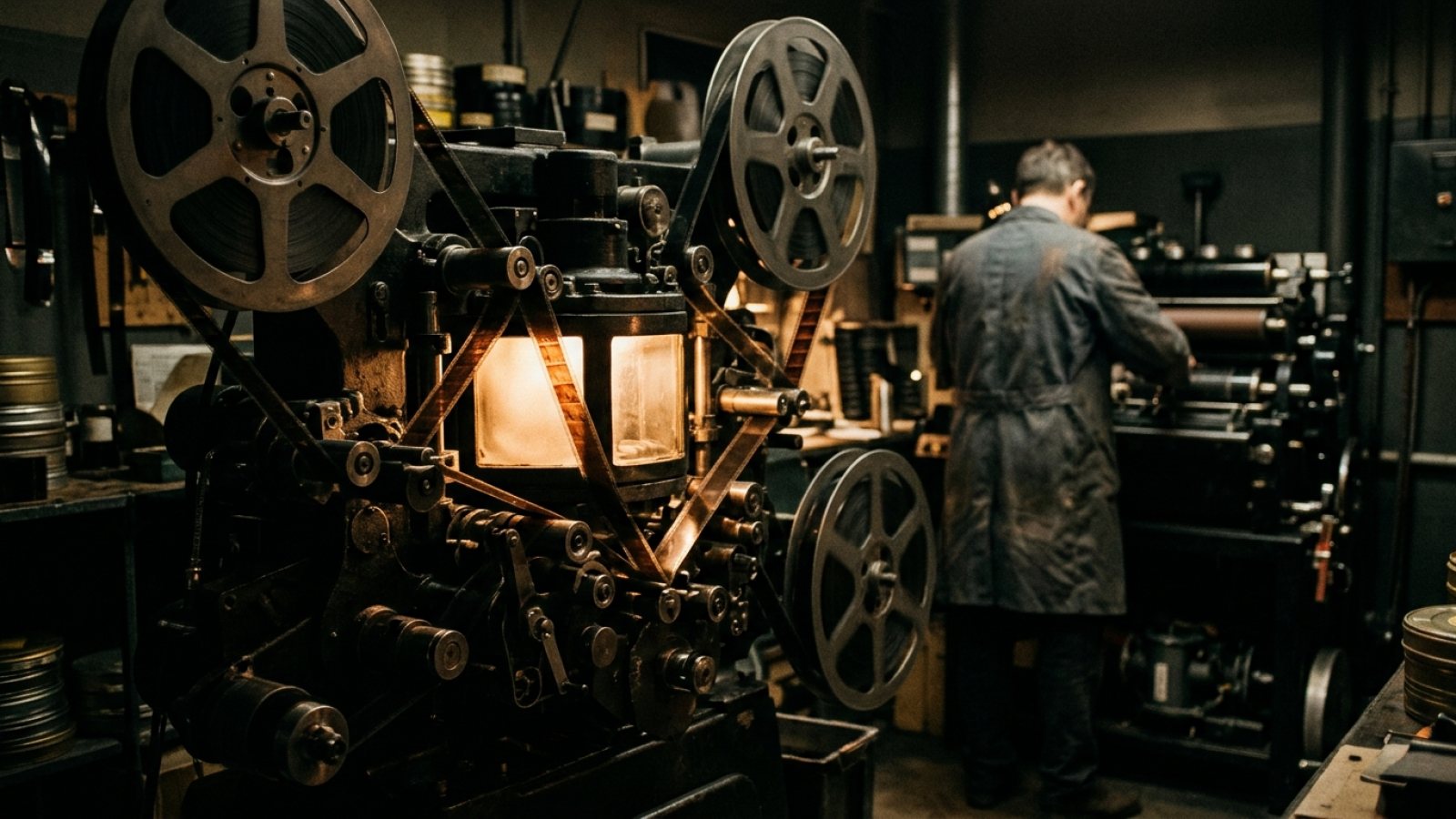
The Bell & Howell Model C: The Contact Printer That Turned Negatives Into Movies
For decades, the Bell & Howell Model C was the industry-standard contact printer, translating camera negatives into finished film prints. Its continuous printing innovation and precise additive lamphouse were central to the studio factory system.
The journey from a camera negative to a finished motion picture print, ready for projection, is a complex industrial process, and at its heart for decades stood the film laboratory printer. This machine was the linchpin, translating fragile original photography into durable copies, and among the most dominant was the Bell & Howell Model C, a continuous contact printer that became an industry standard for its reliability and precision.
Before the advent of continuous printing, film reproduction was a laborious, frame-by-frame affair. Early printers would stop the negative and the raw print stock together, expose a single frame, then advance both films for the next. This intermittent mechanism was inherently slow and placed considerable wear on the film. The breakthrough came with A. S. Howell, co-founder of Bell & Howell, who around 1908-1911, developed the first practical continuous printer. Instead of stopping, the negative and the unexposed raw print stock moved together, in perfect registration, around a curved path past a precisely controlled light source. This innovation dramatically increased printing speed and reduced mechanical stress, laying the foundation for the mass production of films that defined the studio era.
The Workhorse of the Lab Floor
The Bell & Howell Model C quickly established itself as the workhorse of film laboratories worldwide. Originally designed for 35mm, it was also adapted for 16mm production, a format that gained prominence in educational, industrial, and documentary filmmaking. The Model C was, by early standards, a slow-speed machine, operating at approximately 180 feet per minute. Yet its robust construction and consistent output meant it could run tirelessly, often for an entire shift. Over the decades, its design proved so sound that many machines received conversion kits in the 1970s and beyond, boosting speeds and integrating newer technologies. Even today, a few Model C units, alongside 16mm machines like the Model J from the early 1950s, remain in operation in specialized labs, demonstrating the enduring utility of their core design for archival and workprint tasks.
Precision in Light: The Additive Lamphouse
Transforming a black-and-white negative into a color positive print presented a further challenge: maintaining precise color fidelity from scene to scene. Early printers relied on subtractive color filters and manual adjustments. The critical advancement for color printing arrived with the 1961 Bell & Howell additive lamphouse. This sophisticated system utilized dichroic mirrors to split a white light source into its primary red, green, and blue components. For each color, a “light valve,” patented by Willi G. Engel for Bell & Howell in 1966, precisely controlled its intensity. These valves could set each color in 50 distinct steps, where each step represented a finely calibrated change of 0.025 log E (a logarithmic measure of exposure). This meant that a lab timer, the skilled technician responsible for color grading, could specify a desired exposure for each scene using a system of “printer points,” where roughly 12 points would halve or double the exposure for a given color.
The process of “timing” a film involved a timer watching a projected print of the negative, making careful notes of the color and density corrections required for each shot or sequence. These corrections were then programmed into the printer, often via punched paper tape or later, electronic memory. As the raw stock and negative ran through the Model C, the additive lamphouse would adjust the red, green, and blue light levels according to the timer’s instructions, ensuring consistent color and brightness, transforming an initial “answer print” into the director’s desired look.
The Rhythm of the Factory Floor
For the individuals who operated them, these machines were more than just complex mechanisms; they were an integral part of the studio factory’s rhythm. The printing rooms were often kept in near darkness, illuminated only by a safe-light, the constant whirring and clatter of film transport, sprockets, and gears providing a steady backdrop to the technician’s work. The speed at which thousands of feet of film could be precisely duplicated, minute after minute, was a testament to the industrial scale of moviemaking. The Bell & Howell line of printers, later carried on by BHP (Bell & Howell Professional), became synonymous with the rigorous, high-volume demands of a global industry. Their legacy is etched not in the images themselves, but in the unseen, perfectly timed light that brought those images to audiences around the world.
